Practical resources and websites
Here you will find practical resources and website links from Talking Trouble and many other experts in this field.
Our resources are free for you to use provided they are not used for financial gain.
When you are using and sharing this content, please acknowledge Talking Trouble as your source.
We love to hear feedback on how useful you found this content so please email us and let us know what you tried, and how it went. contact@talkingtroublenz.org
Resources developed by Talking Trouble
Bail Conditions Template
A visual version of common conditions given to people on bail and some practical considerations for communicating about bail and other related justice topics
Communication Checklist
We've developed this checklist as a way of understanding someone’s communication strengths and weaknesses. These can be used by you or other people to help you reflect on what you have observed about a person's speech, language and communication profile.
There is also a short version and a one-page version
TTANZ SLT Assessment Communication Checklist young person November 2016 fillable form
TTANZ Rapid Speech Language and Communication Profile Tool 2017
See also the New Zealand Speech-Language Therapists' Association (NZSTA) Giving Voice checklist to help reflect on how communication is at your place/in your service.
Communication Observation Assessment Tool
For Professionals in Youth Justice
We created this tool when providing training with youth justice professionals. The aim of the tool was to provide a structure to help the team consider the barriers to communication that they may want to amend or remove, and to consider the opportunities that could be taken or developed further.
For Legal Professionals
This version is to help legal professionals think about the communication that will take place in a future interaction (with people of any age) so they can plan ahead and get the 'right' accommodations ready.
Communication Passports
People of all ages find a Communication Passport a useful way to share what they want others to know and do to help communication go more smoothly. Each communication passport needs to be personalised for - and by - the person it is for.
PDF version : TTANZ communication passport templates
PowerPoint (editable): TTANZ communication passport templates
Here are some practical considerations to bear in mind when ‘Creating Communication Passports’: Communication Passport Considerations Talking Trouble March 24
Guidance
Good communication practice in Family Group Conferences
Guidance on helping everyone have their say
How to improve communication accessibility in legal spaces
This one-page information sheet celebrates 13 actions that people working in courts and other legal spaces can take to help to create a communication accessible setting.
How to improve communication in virtual meetings
These resources were created during COVID lockdowns and provide suggestions about what to consider and what to do (and not do). We also collaborated with Intermediaries for Justice to make an international version.
Virtual meeting planning (professionals international version)
Virtual meeting planning (participants - 1 pager international version)
Virtual meeting planning (participants - 4 pager international version)
Lego Therapy
Adapted from work we observed and discussed with members of the Salford Youth Offending Team in the United Kingdom.
Te Reo Māori
Developed during Te Wiki o Te Reo Māori and exploring some key concepts.
Visual Aids
How to improve communication
Our Communication Postcards are designed to help professionals think about what they can do differently to help people participate. They were developed as part of a project we completed with social workers and Family Group Conference coordinators at Oranga Tamariki Youth Justice.
Youth Voices about Youth Justice
As part of our Youth Voices about Youth Justice report, we created a set of postcards for use.
Or watch an animation and download a copy of the report here
Conversations about mental health
Developed over the years with various teams, including mental health, youth justice and social worker teams. These can support discussion of a range of issues related to mental health and wellbeing.
Resources and websites from across Aotearoa
Guidance
Easy Read: Guidance on producing clear written information – People First
Easy Read documents present information using simple words and pictures that make information easier to understand. It can help anyone with reading or comprehension difficulties, including those with learning disabilities, learning difficulties and also people for whom English is not their first language.
See also international examples from Change People and from Key ring
We can provide a service to make your materials in an “Easy Read” format – contact us to discuss
Engaging with people with complex communication needs – Ministry for Disabled People
Te Reo Māori
How to structure your pepeha (Dr Hinemoa Elder - Aotearoa Brain Project)
Resources
Communication assistance - Benchmark
Best practice-best evidence with vulnerable people. Highly detailed toolkits for professionals involved with the law, including a thorough guide to Communication Assistant roles which includes case law references and practical advice
Restorative Practice and Restorative Justice in Schools – Ministry of Education
Videos and materials from the Ministry of Education’s PB4L website by Professor Chris Marshall that consider how schools might become Restorative Practice contexts.
Supported Decision Making and Safeguarding - IHC
Bail conditions template from IHC
Websites
New Zealand Justice – Kelly Howard. Research conducted at The University of Auckland and concerning the use of Communication Assistants in Youth Justice settings in New Zealand. Kelly's research has been supervised by one of Talking Trouble's Academic Advisors, Dr Clare McCann.
Oranga Tamariki Contact Oranga Tamariki if you are concerned about a child or young person:
Support my decisions Resources to enable supported decision making
Talking Matters project Auckland initiative involving many community partners to foster oral language in preschoolers
The Personal Advocacy and Safeguarding Adults Trust Contact PASAT if you are concerned about an adult at risk for advice and support: "Safeguarding is a range of activities and response that promote and protect human rights, health, wellbeing and culture, and prevent or reduce harm, abuse and neglect".
Voices of Mokopuna - NZ Children's Commissioner Useful and practical advice and ideas for anyone or any organisation wanting to engage with children and young people to hear their views.
Resources and websites from international sources
Guidance
England/ Wales Ministry of Justice Procedural Guidance Manual for Registered Intermediaries
Procedural manual for registered intermediaries
Youth Justice Board – England and Wales
Speech, language, communication and neuro-disability screening tool.
Research and resources
Attachment and Parenting - Circle of Security
Communication needs in Young Offenders - RCLST
The Royal College of Speech Language Therapists in the UK have run an extremely active and successful campaign to raise awareness of the communication needs of young offenders.
Communication Tools for Body, Mind and Spirit – Pip Wilson and Ian Long.
Resources that help with emotions and behaviour in a highly visual way:
The Communication Trust
Many free resources for parents/carers and professionals about meeting speech, language and communication needs:
Evidence submitted concerning youth justice and communication skills to a UK parliamentary select committee in March 2012.
Film and booklet from the Sentence Trouble Project designed for professionals working in Youth Justice about language and communication.
Developmental language disorder - CATALISE
CATALISE has worked on developing terminology and frameworks for talking about language difficulties in children.
Article: Terminology
Explaining key legal concepts - Blurred Borders – Australia
Resource Kits and visual resources for legal and community service providers
Impact of trauma on children – Various sources
Life Story Work – Richard Rose has authored some very useful books and delivers training for anyone wanting to assist children to understand their own lives and have a way of talking about what has happened to them. Great ideas for developing emotional literacy too.
Richard Rose's 'Serve and Return' This short video provides an explanation of how attachment develops between children and parent and how this process can be disrupted.
The language of emotions - Do2Learn
Resources for creating visuals for day-to-day life at home and school, and on developing an awareness of the language involved in emotions.
Literacy – Education and Training Foundation – UK
Oral Language
A wide range of oral language resource packs that can be downloaded and photocopied. Some relate specifically to language related to emotions/behaviour and social skills.
Speech, language and communications difficulties. Young people in trouble with the law - Nacro
Nacro is a UK-based social justice charity dedicated to supporting vulnerable and disadvantaged individuals to achieve independence and a better future.
Supporting accessible communication in justice settings – Royal College of Speech Language Therapists – UK
A range of resources from the RCSLT
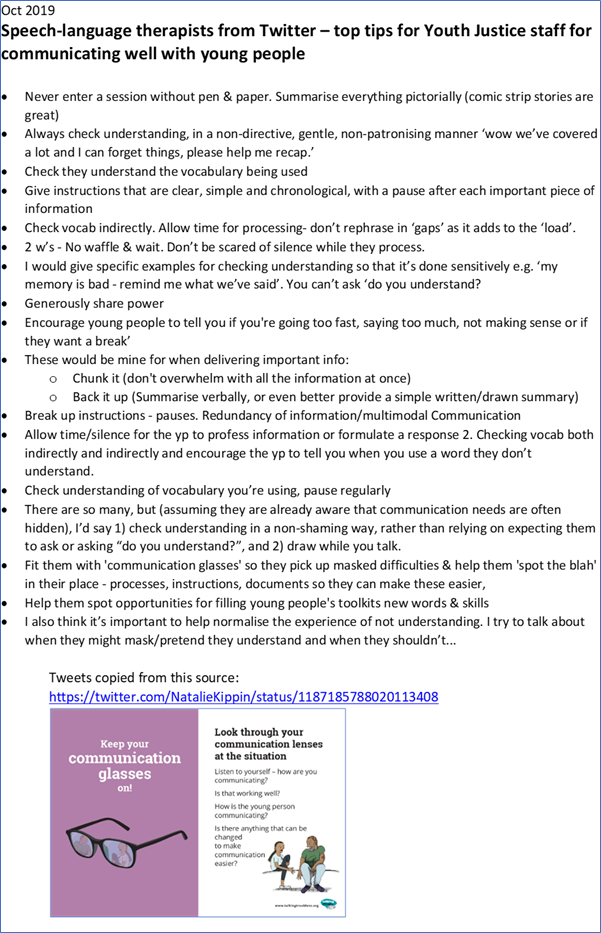
Top tips for Youth Justice staff
This list originated from Twitter when Natalie Kippen (speech-language pathologist and researcher from Perth) asked: “SPs/SLTs in #youthjustice, you are giving frontline staff 2 points to think about/tips to use, re:#communication, when working w youth. what are they?”
Visual Communication Frameworks - Talking Mats
The Talking Mats website contains an enormous wealth of resources for professionals working across a wide range of sectors, including entries about justice, education, social work, behaviour, forensic health as well as many others.
Talking Trouble have to Accredited Talking Mats trainers in our team and regularly deliver Talking Mats courses with our colleagues from TalkLink. If you haven't done Talking Mats training, do it, as you won't regret having more tools to help you consult with others. Contact us
Understanding why someone is in care - Bright spots - UK
Useful research and resources to help children and young people understand why they are in care
‘Up Goer 5’ text editor
A tool to help you understand whether you are using words that occur most commonly in English
Websites
The Advocate’s Gateway A website for law professionals providing plenty of evidence-based information about engaging with vulnerable witnesses and defendants. Videos, tool kits and resource lists are included.
Banter - David Kinnane - Australia Accessible and practical ideas for supporting children and young people's language and communication development.
Dyadic Developmental Psychotherapy - Dan Hughes Dan's work has developed Dyadic Developmental Psychotherapy: Attachment Focused Treatment for Childhood Trauma & Abuse, and his website provides useful resources for those working in this area
Experiencing trauma - Jasper Mountain Jasper Mountain is a place created to pioneer approaches that work for children who have tried just about everything else.
Hanen Resources designed to support parents/carers or professionals to develop strategies to use speech, language and communication-enabling strategies in their own contexts (home, education, etc). Mostly aimed at early, preschool and primary aged groups.
Language and literacy in young people - Dr Suze Leitao - Curtin University in Perth
Lift My Skills Academy Practical resources to work through to develop skills like assertive communication skills or better strategies to deal with anger and other emotions
Margaret Thorsbone Videos and materials from a consultancy providing services to schools, community groups and workplaces to achieve transformational change through restorative practice. Includes a link to her books written with Nick Burnett, called Restorative Practice and Special Needs.
Dr Nathaniel Swain 'Read the Research' series kicks off with a fantastic paper by Dr Maxine Winstanley on justice/developmental language disorders. Winstanley, M., Webb, R. T., & Conti‐Ramsden, G. (2019). Psycholinguistic and socioemotional characteristics of young offenders: Do language abilities and gender matter?